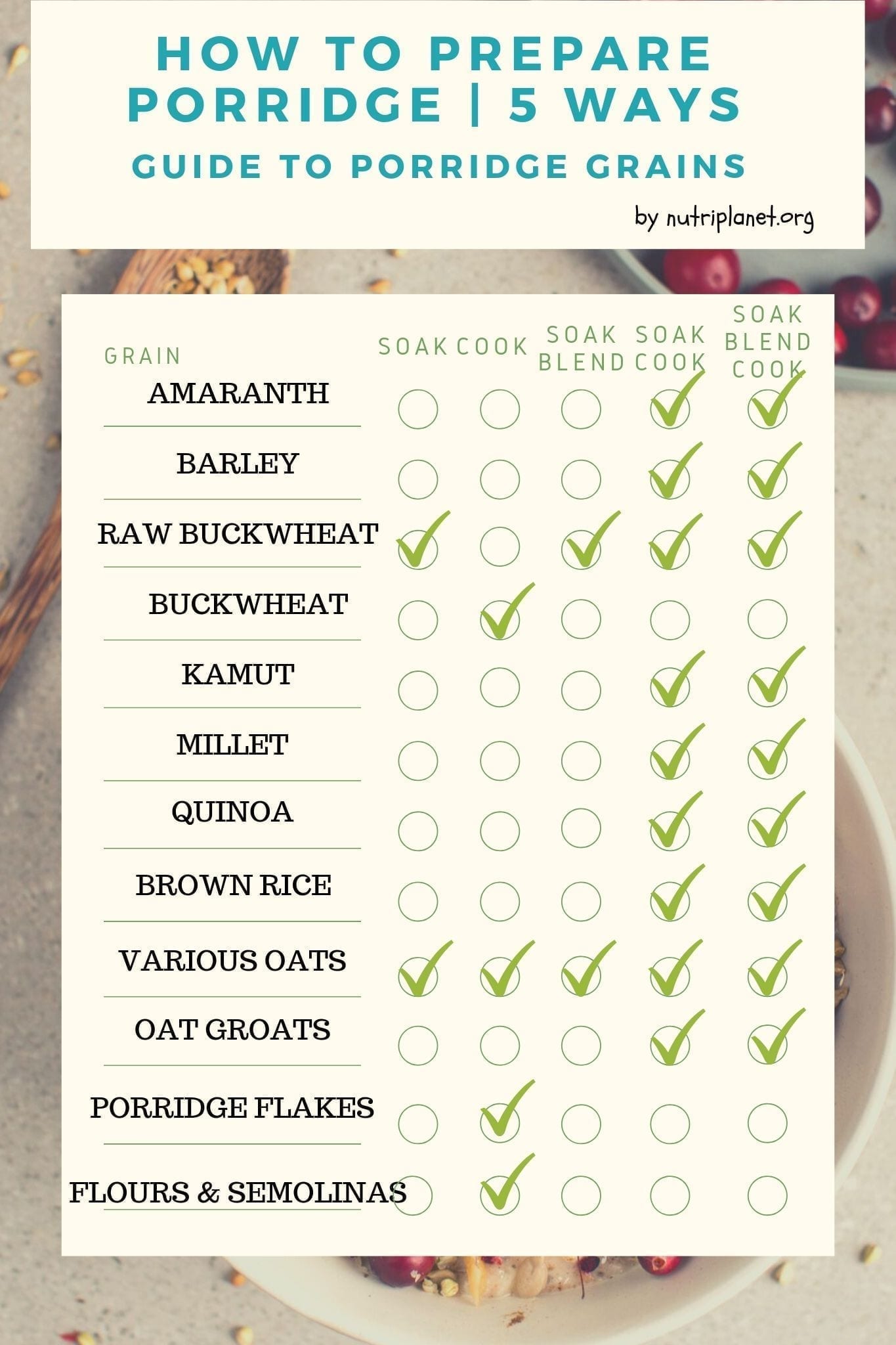
The below chart gives you a quick overview of what can be done with your favourite grains:
1. Soaking
You can prepare your nutritious porridge by just soaking with a few grains:
Oats
Oats are definitely one of my favorites to use for making porridge as it’s ready in no time and has an awesome texture and taste. You can choose between different types of oats for soaked porridge:
Jumbo rolled oats or flakes – whole oats that have been softened with steam and then flattened between rollers to make flakes. You can make a really quick porridge using jumbo oats as they absorb the liquid in no time.
Rolled oats – steel cut oats that have been softened with steam and then rolled to produce flakes. They are smaller than jumbo flakes and cook quicker making a finer, smoother porridge.
Oatmeal – made by using grooved rolls to break up the oats to produce different grades of oatmeal, from coarse oatmeal, to medium or fine oatmeal. Use fine oatmeal for soaking.
Directions
Add hot water and/or plant-based milk to your oats, cover and let sit for 5-10 minutes depending on the oats you’re using. Jumbo rolled oats will be ready in a few minutes whereas oatmeal takes longer.
You could go ahead and blend your soaked oats as well, if you want your porridge to be super creamy.
3. Soaking + Blending + Cooking, Video
I guess this method is unknown to many of you. I first tried blended batters for pancakes, bread, muffins and cakes and then thought why not make porridge as well.
I recommend this method to those who enjoy porridges made of flour for their creaminess. With soaking + blending + cooking you have the same result, but at the same time you get a much healthier porridge, as soaking makes the grains more easily digestible and enhances the absorption of minerals.
The grains that you can use for soaking + blending + cooking:
Raw buckwheat groats, quinoa berries, millet berries, amaranth berries, oat groats, steel cut oats, oatmeal, and barley groats.
Oat and barley groat porridge prepared using this method will not be creamy, but a bit chunky as oat and barley groats are harder than other grains in this list.
Directions
Soak grains according to the soaking chart below, then rinse and drain.
Throw soaked grains into blender with some plant-based milk and/or water and blend into homogenous batter.
Cook the batter for about 5 minutes and add liquid if necessary. The amount of liquid entirely depends on the desired consistency. Remember, you can always add some more, but can’t take away! Check the chart below for tips.
Go ahead and also try soaking + cooking + blending. In this case it is easier to use immerse blender in the same pot after you have cooked your grains. I personally prefer blending + cooking because the preparation time is much shorter.
In this video I make creamy millet amaranth porridge using soaking + blending + cooking method.
4. Soaking + Cooking
This method applies to whole groats and berries: raw buckwheat groats, quinoa berries, millet berries, amaranth berries, barley groats, oat groats, kamut berries, and whole grain rice.
Your can also soak + cook various types of oats (steel cut, rolled, meal), if you like your porridge warm rather than cold.
Directions
Soak grains according to the soaking chart below, then rinse and drain.
Cook in water and/or plant-based milk according to the chart below.
Just measure, add liquid and cook without any soaking or blending:
Porridge flakes
There are porridge flakes of all grains you can imagine – buckwheat, millet, quinoa, kamut, amaranth, oats, rice, spelt, rye, barley, multi-grain, wheat.
Just choose whole grain and possibly organic porridge flakes and prepare them according to the instructions on the package.
Steel cut oats, rolled oats, bran and oatmeal
Follow the instructions on package.
Oatmeal takes longer to cook and usually has a much thicker texture compared to rolled oats.
Semolina and flours
Semolina is basically a coarse grind of a grain or corn, i.e. barley semolina, corn semolina, wheat semolina, spelt semolina, rye semolina, and buckwheat semolina.
Tips:
Follow the instructions on the package in terms of semolina and water ratio as well as cooking time and add some more liquid if you’d like it more moist.
Flour porridges usually cook for 10 minutes whereas semolina takes about 20 minutes. For me also 10 minutes active cooking + 10 minutes resting (covered) works very well.
Use a whisk when pouring semolina or flour into boiling water to avoid any lumps.
I also use the following trick when making flour porridges – I put flour in a glass and gradually add water to get a pourable homogeneous batter and then add the batter to boiling water while whisking. I find it much easier than messing with dry flour.
Note:
Always choose whole grain semolina and whole grain flours with coarser grind.
Pre-roasted buckwheat porridge (kasha)
There is no need to soak pre-roasted buckwheat to make porridge.
Directions
For a grit result take 1 part of groats and 1 ¾ parts of water. Should you like it creamier, add liquid.
Rinse and drain pre-roasted groats and boil for 18-20 minutes.
In my opinion pre-roasted buckwheat goes well with vegetables (grated carrot, pumpkin puree) and not with fruits or berries.
Be cautious with millet to use in your nutritious porridge!
If you have a thyroid condition, avoid millet as it has adverse effects on thyroid function.
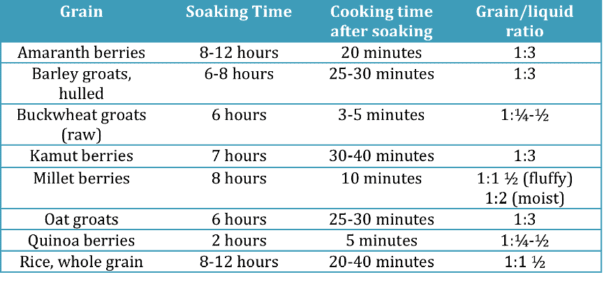
Here’s the soaking, cooking time and grain/liquid ratio chart I’ve been mentioning above:
Notes for nutritious porridge:
Grain and liquid ratio 1:3 means that you measure one part of dry berries or groats, soak them in water for required time and then cook them with 3 parts of liquid.
The cooking time depends on how old your groats or berries are and how much water they have absorbed while soaking.
The grain and liquid ratio can vary according to your personal taste and liking.
It is recommended to start cooking with water only and add plant-based milk at the end to moist the porridge as grains absorb water better.
Cook without salt and add it only at the end as salt can inhibit water absorption.
Hi Nele, I bought a pack of buckwheat groats thinking it was raw since it didn’t say on the package. My aim was to make your buckwheat bread so I prepared to soak first. Without paying much attention to the smell that came out as I opened the bag I proceeded to soak for up to 8 hrs. After, as I tried rinsing it out, I perceived the same strong smell again and noticed there was no slime! So I took the pack to cross check if it indicated if it was roasted or not! I concluded it was roasted! Now, I’m left with a doubled batch of 425g of soaked Kasha. I don’t know what to do with it. I don’t think you have any recipes for it. Do you know how I can use it so it doesn’t waste? Thanks
Hi! What a bummer ? Anyway, no need to waste it! I’d suggest you boil the groats and either eat as porridge in the morning and/or add to salad bowls or make a stew with onions, garlic and other veggies. You can either use Mediterranean herbs or Indian spices for flavour. I hope this helps!
Every day your feed is full of messages designed to make you feel less than, not enough, behind.
And most of the time you don’t even notice it’s happening.
Because it’s targeting something much deeper — a core belief that so many of us carry:
I’m not enough the way I am.
I’ve become allergic to this kind of messaging. And I’m consciously choosing to do things differently.
Fear and urgency will never be part of how I communicate with you. 🌿
The full reflection is on YouTube — DM me and I’ll send you the link directly. 💛
Now tell me — have you noticed this in your own feed or inbox? What does it do to you? I’d love to hear your experience below.
Sending you lots of light and love 🌞💚
Nele
I also welcome you on👧🙋♀️
𝙁𝙖𝙘𝙚𝙗𝙤𝙤𝙠: nutriplanet.health.hub
𝙋𝙞𝙣𝙩𝙚𝙧𝙚𝙨𝙩: nutriplanet
𝙏𝙬𝙞𝙩𝙩𝙚𝙧: thenutriplanet
𝙔𝙤𝙪𝙏𝙪𝙗𝙚: @nutriplanet
May this reach those who are asking.�May it move only where it’s welcome —�and may that be enough.
#fearbasedmarketing #innerwork #consciousmarketing
This vegan tiramisu took me months to perfect — and it was absolutely worth it. 🤌
Creamy, indulgent, and completely plant-based. My son would eat it every day if he could. 🙃
Made with a cashew + silken tofu cream that’s honestly to die for, whole grain oat cookies, and a splash of decaf espresso. No dairy, no eggs — just pure plant-based indulgence.
Perfect for Easter — or honestly, any day you need something beautiful and nourishing.
One question: do you know a good-quality, additive-free rum alternative? Drop it in the comments — I’d love to try it!
💛 Comment TIRAMISU below and I’ll send you the full recipe card.
Sending you lots of light and love 🌞💚
Nele
I also welcome you on👧🙋♀️
𝙁𝙖𝙘𝙚𝙗𝙤𝙤𝙠: nutriplanet.health.hub
𝙋𝙞𝙣𝙩𝙚𝙧𝙚𝙨𝙩: nutriplanet
𝙏𝙬𝙞𝙩𝙩𝙚𝙧: thenutriplanet
𝙔𝙤𝙪𝙏𝙪𝙗𝙚: @nutriplanet
May this reach those who are asking.�May it move only where it’s welcome —�and may that be enough.
#vegantiramisu #plantbaseddessert #veganeaster
For almost 2 months now, I’ve been eating savoury porridges for breakfast.
Here’s why:
• More satiety
• Stable blood sugar and energy
• No need to snack before lunch
• Sufficient protein from lentils + whole grains
At 45+, this matters.
I always add broccoli sprouts — one of the richest sources of sulforaphane, known for its anti-inflammatory and hormone-supportive properties.
And something people underestimate:
How you eat matters as much as what you eat.
When you slow down and eat mindfully, digestion shifts. Absorption shifts. Energy shifts.
Want to try savoury porridges?
Comment “PORRIDGE” and I’ll send you the 5 recipes + tips to start.
Sending you lots of light and love 🌞💚
Nele
I also welcome you on👧🙋♀️
𝙁𝙖𝙘𝙚𝙗𝙤𝙤𝙠: nutriplanet.health.hub
𝙋𝙞𝙣𝙩𝙚𝙧𝙚𝙨𝙩: nutriplanet
𝙏𝙬𝙞𝙩𝙩𝙚𝙧: thenutriplanet
𝙔𝙤𝙪𝙏𝙪𝙗𝙚: @nutriplanet
May this reach those who are asking.�May it move only where it’s welcome —�and may that be enough.
#plantbasedbreakfast #womenover40health #broccolisprouts
I shared a very real moment recently — missing a flight, feeling fear rise in my body, and choosing to soften instead of spiral.
This isn’t about positive thinking.
It’s about what happens when you meet stress in real time — in your body, not just your mind.
I shared the full reflection (and a short chanting practice at the end) on YouTube.
If you feel curious or this speaks to you, comment VIDEO and I’ll send you the link 💚
Take what resonates. Leave the rest.
⬇️ save this to come back to it
💚 follow for more embodied insights
Sending you lots of light and love 🌞💚
Nele
I also welcome you on👧🙋♀️
𝙁𝙖𝙘𝙚𝙗𝙤𝙤𝙠: nutriplanet.health.hub
𝙋𝙞𝙣𝙩𝙚𝙧𝙚𝙨𝙩: nutriplanet
𝙏𝙬𝙞𝙩𝙩𝙚𝙧: thenutriplanet
𝙔𝙤𝙪𝙏𝙪𝙗𝙚: @nutriplanet
May this reach those who are asking. May it move only where it’s welcome — and may that be enough.
#embodiedpresence #lettinggo #innerwork
One of the most important insights I’ve received recently is this:
Noticing a pattern is just the beginning — not the transformation.
Yes, awareness matters.
It allows you to step back and observe instead of reacting.
But what comes after awareness is where most people get stuck.
Because embodiment takes time.
I’ve noticed this in myself with negativity.
When others are negative, I get triggered — because I see that part in me.
The part I don’t want to carry anymore.
And no, it’s not as simple as “just be positive.”
What actually helps is this:
Words and actions are vibration.
Even before your body fully believes it.
So when you catch yourself slipping into an old pattern,
take a step back — and consciously choose different words or different actions.
Even if it feels mechanical at first.
Even if it doesn’t feel embodied yet.
It’s like training a muscle.
When you consistently choose a higher response through words and actions,
the body follows — sooner or later.
This is how patterns soften.
This is how embodiment begins.
If this resonates:
⬇️ save this to come back to it
💚 follow for more embodied insights
📩 or comment NEWSLETTER if you want to explore these themes more deeply with me
Sending you lots of light and love 🌞💚
Nele
I also welcome you on👧🙋♀️
𝙁𝙖𝙘𝙚𝙗𝙤𝙤𝙠: nutriplanet.health.hub
𝙋𝙞𝙣𝙩𝙚𝙧𝙚𝙨𝙩: nutriplanet
𝙏𝙬𝙞𝙩𝙩𝙚𝙧: thenutriplanet
𝙔𝙤𝙪𝙏𝙪𝙗𝙚: @nutriplanet
May this reach those who are asking. May it move only where it’s welcome — and may that be enough.
#NervousSystemHealing #EmbodiedAwareness #PatternInterrupt
These soft gingerbread cookies are one of those quiet wins in the kitchen.
Made with:
🌿 chickpeas
🌰 almonds
🍯 date sugar
🥜 nut butter
🍫 carob + cacao
✨ warming gingerbread spices
They’re naturally sweetened, plant-based, and surprisingly satisfying — soft on the inside, grounding, and gentle enough to enjoy during the holidays without that heavy after-feeling.
I love recipes like this because they remind us that festive food doesn’t have to be all-or-nothing.
You can enjoy seasonal favourites and still feel good in your body.
📩 Comment GINGER and I’ll send you the recipe.
(P.S. You’ll receive the same gingerbread recipe guide I shared recently — perfect if you missed it or want it saved.)
📩 Save this for later, and feel free to follow along if you’d like more gentle guidance and support 💛
Sending you lots of light and love 🌞💚
Nele
I also welcome you on👧🙋♀️
𝙁𝙖𝙘𝙚𝙗𝙤𝙤𝙠: nutriplanet.health.hub
𝙋𝙞𝙣𝙩𝙚𝙧𝙚𝙨𝙩: nutriplanet
𝙏𝙬𝙞𝙩𝙩𝙚𝙧: thenutriplanet
𝙔𝙤𝙪𝙏𝙪𝙗𝙚: @nutriplanet
May this reach those who are asking. May it move only where it’s welcome — and may that be enough.
#plantbasedholidays #wholefoodbaking #gingerbread
If you’d like to try these nourishing gingerbread cookies yourself, you can get the full recipe here
Gingerbread cookies that leave you feeling good — even after 🍪✨
Years ago (more than 12 to be precise), holiday baking either spiked my energy or made me feel worse —
until I started creating treats that supported my body instead of draining it.
These gluten-free gingerbread cookies are made from whole, grounding plant-based ingredients:
✔ almonds (soaked + dehydrated for digestibility)
✔ raw buckwheat + oats
✔ tahini
✔ date paste
✔ warm spices + flax
No refined sugar.
No oils.
Just fibre, minerals, and slow-release sweetness your body can actually work with.
They’re rustic, nourishing, and deeply satisfying —
the kind of cookie you can enjoy without the crash.
If you want the exact recipe, comment GINGER below and I’ll send it to you. 🎄💛
📩 Save this for later, and feel free to follow along if you’d like more gentle guidance and support 💛
Sending you lots of light and love 🌞💚
Nele
I also welcome you on👧🙋♀️
𝙁𝙖𝙘𝙚𝙗𝙤𝙤𝙠: nutriplanet.health.hub
𝙋𝙞𝙣𝙩𝙚𝙧𝙚𝙨𝙩: nutriplanet
𝙏𝙬𝙞𝙩𝙩𝙚𝙧: thenutriplanet
𝙔𝙤𝙪𝙏𝙪𝙗𝙚: @nutriplanet
May this reach those who are asking. May it move only where it’s welcome — and may that be enough.
#plantbasedholidays #wholefoodbaking #gingerbread
‼️NB! Comment GINGER!‼️Gingerbread cookies your nervous system will thank you for. 🍪✨
Years ago (more than 12 to be precise), holiday baking either spiked my energy or made me feel worse —
until I started creating treats that supported my body instead of draining it.
These gingerbread cookies are made from whole, grounding ingredients:
✔ almonds (soaked + dehydrated for digestibility)
✔ raw buckwheat + oats
✔ tahini
✔ date paste
✔ warm spices + flax
No refined sugar.
No oils.
Just fibre, minerals, and slow-release sweetness your body can actually work with.
They’re rustic, nourishing, and deeply satisfying —
the kind of cookie you can enjoy without the crash.
If you want the exact recipe, comment GINGER below and I’ll send it to you. 🎄💛
📩 Save this for later, and feel free to follow along if you’d like more gentle guidance and support 💛
Sending you lots of light and love 🌞💚
Nele
I also welcome you on👧🙋♀️
𝙁𝙖𝙘𝙚𝙗𝙤𝙤𝙠: nutriplanet.health.hub
𝙋𝙞𝙣𝙩𝙚𝙧𝙚𝙨𝙩: nutriplanet
𝙏𝙬𝙞𝙩𝙩𝙚𝙧: thenutriplanet
𝙔𝙤𝙪𝙏𝙪𝙗𝙚: @nutriplanet
May this reach those who are asking. May it move only where it’s welcome — and may that be enough.
#nervoussystemregulation #holidaybaking #wholefoodrecipes
Drumming and voice work can calm your nervous system faster than any mindset technique — and here’s why.
Most people know drumming as something loud, rhythmic, or expressive —
but not many realize how deeply it can support the body in regulating stress and returning to ease.
Slow, steady drumming has been used for centuries to help the nervous system:
• ground
• soften
• regulate
• release tension
• return to the present moment
And when it’s paired with voice, humming, or chanting,
it activates the vagus nerve — one of the most powerful pathways to calm.
For years, I felt a quiet pull toward the drum…
but I only received my own a little over a month ago.
And the moment I began drumming — especially while chanting —
something activated in me instantly.
Then, during a Drum’s Tongue workshop I attended,
this part of my work opened even more.
It feels new, tender, but deeply true.
So I’ve created a free mini drum journey
— a short grounding practice to help you reconnect with your body and your breath.
If you’d like to experience it,
comment DRUM below and I’ll send it to you 💛
Follow me for more guidance and support!
Sending you lots of light and love 🌞💚
Nele
I also welcome you on👧🙋♀️
𝙁𝙖𝙘𝙚𝙗𝙤𝙤𝙠: nutriplanet.health.hub
𝙋𝙞𝙣𝙩𝙚𝙧𝙚𝙨𝙩: nutriplanet
𝙏𝙬𝙞𝙩𝙩𝙚𝙧: thenutriplanet
𝙔𝙤𝙪𝙏𝙪𝙗𝙚: @nutriplanet
May this reach those who are asking. May it move only where it’s welcome — and may that be enough.
#nervoussystemregulation #soundhealingjourney #embodiedhealing
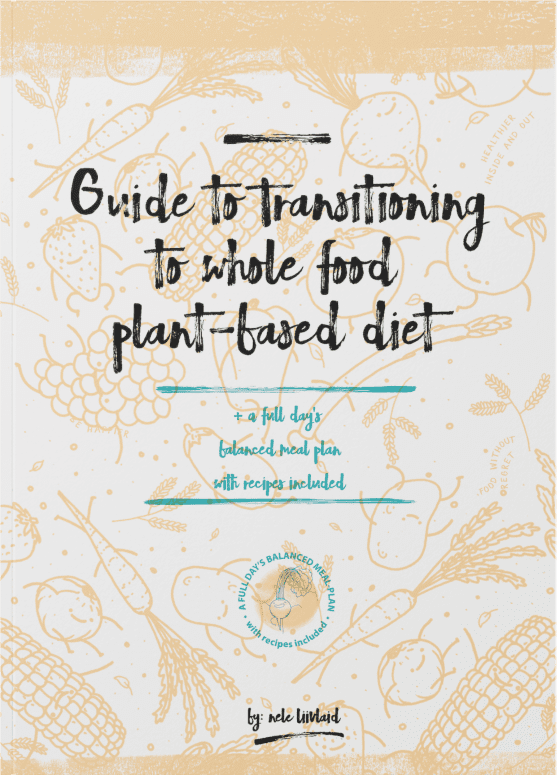
Learn the secrets of sustained lifestyle change for weight loss, better health and happiness in my new 85-pagePractical Guide to Transitioning to Healthy Whole Food Diet including a full day’s meal plan.






















Thank you.. your video’s are amazing!! Thank you so much for sharing your knowledge.
Thank you so much Tiffany! I’m so glad that you find my work helpful!
Hi Nele, I bought a pack of buckwheat groats thinking it was raw since it didn’t say on the package. My aim was to make your buckwheat bread so I prepared to soak first. Without paying much attention to the smell that came out as I opened the bag I proceeded to soak for up to 8 hrs. After, as I tried rinsing it out, I perceived the same strong smell again and noticed there was no slime! So I took the pack to cross check if it indicated if it was roasted or not! I concluded it was roasted! Now, I’m left with a doubled batch of 425g of soaked Kasha. I don’t know what to do with it. I don’t think you have any recipes for it. Do you know how I can use it so it doesn’t waste? Thanks
Hi! What a bummer ? Anyway, no need to waste it! I’d suggest you boil the groats and either eat as porridge in the morning and/or add to salad bowls or make a stew with onions, garlic and other veggies. You can either use Mediterranean herbs or Indian spices for flavour. I hope this helps!
Thanks Nele. How do I cook it without it getting mushy since it’s already soaked ?
Hi! Add very little water so that you basically steam the groats.